Website Transformation & GTM Engine
-
Focus
Turn Pindrop’s website from a hard-to-edit, slow-to-update brochure with a fragmented product story and major accessibility/ADA compliance gaps into an accessible GTM engine and evaluation hub that told the right story for our ICPs and drove higher-intent traffic and more qualified demos.
-
Role
Director of Brand & Creative, leading the website transformation end-to-end—strategy, information architecture, UX, and narrative—while partnering with Product Marketing, Sales, Product, and Research to align the web experience to real buying journeys and sales conversations.
Problem
Pindrop’s website had become a drag on GTM instead of a partner to it:
It behaved like a static brochure, not a place where a buying committee could do real evaluation.
The product story was fragmented across decks, PR, analyst notes, and internal diagrams; the version on the site didn’t match how we actually won deals.
The site was hard to edit and slow to update—even small changes took too long and required specialists, which meant Marketing couldn’t react quickly to new threats, launches, or narrative shifts.
There were accessibility/ADA gaps across headings and structure, contrast, and interactions.
For our ICPs (CISOs, fraud/risk leaders, and contact center decision-makers), that meant:
It was hard to understand what Pindrop actually did and how it fit in their environment.
There wasn’t a clear, credible path from “this is interesting” to “I know how this would work here.”
The website wasn’t giving them the evidence they needed to sponsor a high-stakes recommendation.
For the business:
The company and product narratives were out of sync with what buyers saw in PR, campaigns, and other GTM channels.
Sales had to rebuild the story manually for every call.
Marketing couldn’t move fast enough to support GTM and product launches.
The website wasn’t pulling its weight as a channel for qualified demand or late-stage validation.
We rebuilt Pindrop.com as a modular, story-first system that aligned brand, product, PR, and sales narratives, gave buyers a clear, credible evaluation path, and put page creation in the hands of Marketing and Design.
The final outcome: A high-performing, living website grown and managed from a shared library of 55+ reusable components in Figma and WordPress. Launch time for new marketing pages and sections dropped from 8–12 weeks to 1–3 days, so marketers and designers could ship net-new experiences without a developer, turning the site from a bottleneck into a fast-moving GTM tool. We also layered in heatmapping and behavior analytics, so marketing and sales can see which stories, sections, and proof points actually move buyers down-funnel and into closed-won deals.
Solution + Impact
+88%
Increase in engagement
More buyers actually stay with the story because page flows are clearer and every screen gives them a reason to keep going.
+165%
Lift in engaged sessions
High-value visits nearly tripled as modular pages and smarter cross-linking pull people deeper into product, solution, and insights paths.
—75%
Drop in bounce rate
Far fewer visits are wasted now that above-the-fold messaging and obvious next steps make it clear what to do after landing.
+40%
Growth in high-intent traffic
A stronger information architecture and on-page SEO bring in more visitors from organic, paid, and referral channels who are already evaluating vendors (roughly 27–43% lift across those sources).
+56%
Increase in blog session length
Decision-makers spend more time reading because the Research & Insights hub clusters related topics into coherent, bingeable streams.
+38%
Increase in engaged blog visits
A larger share of readers move from a single article into deeper exploration, driven by author pages, tagging, and “next up” recommendations.
55+
Reusable components & design elements
The visual system and page layouts are built from modular pieces, so new products, mediums, and narratives can be added without breaking consistency or restarting a redesign.
-90%
Reduction in launch time for new pages
Marketing and Design can ship net-new pages in days instead of months after cutting launch cycles from roughly 8–12 weeks to 1–3 days using the shared component library.
How we did it
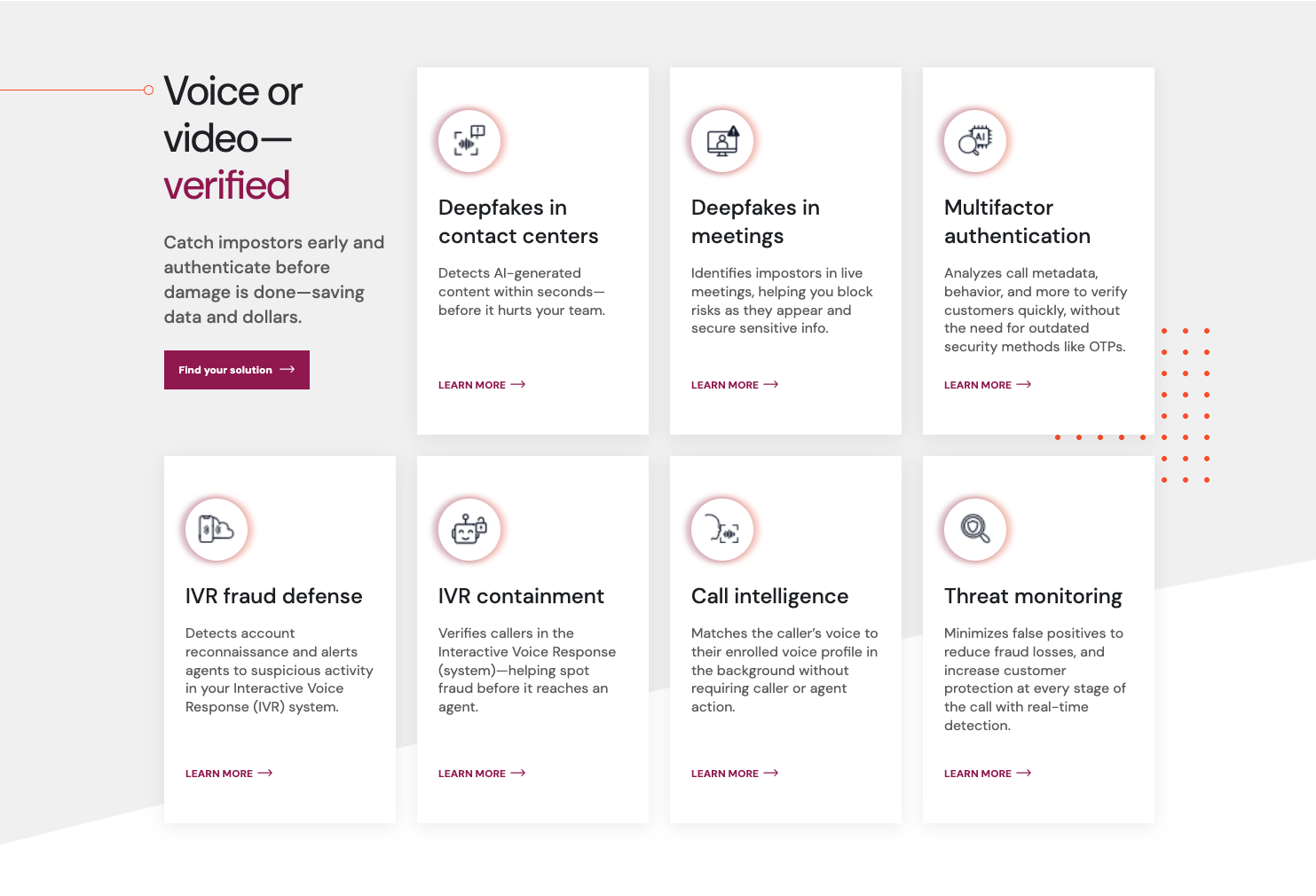
We rebuilt Pindrop.com on a shared component system in Figma and WordPress, with 55+ reusable layouts, modules, and UI elements. Each page is now assembled from this library—so Marketing and Design can ship entirely new sections without a developer, while the design language stays consistent as the product roadmap expands into new signals and mediums.
Componant library
& custom built CMS
Reframed IA,
URL, Metadata structure
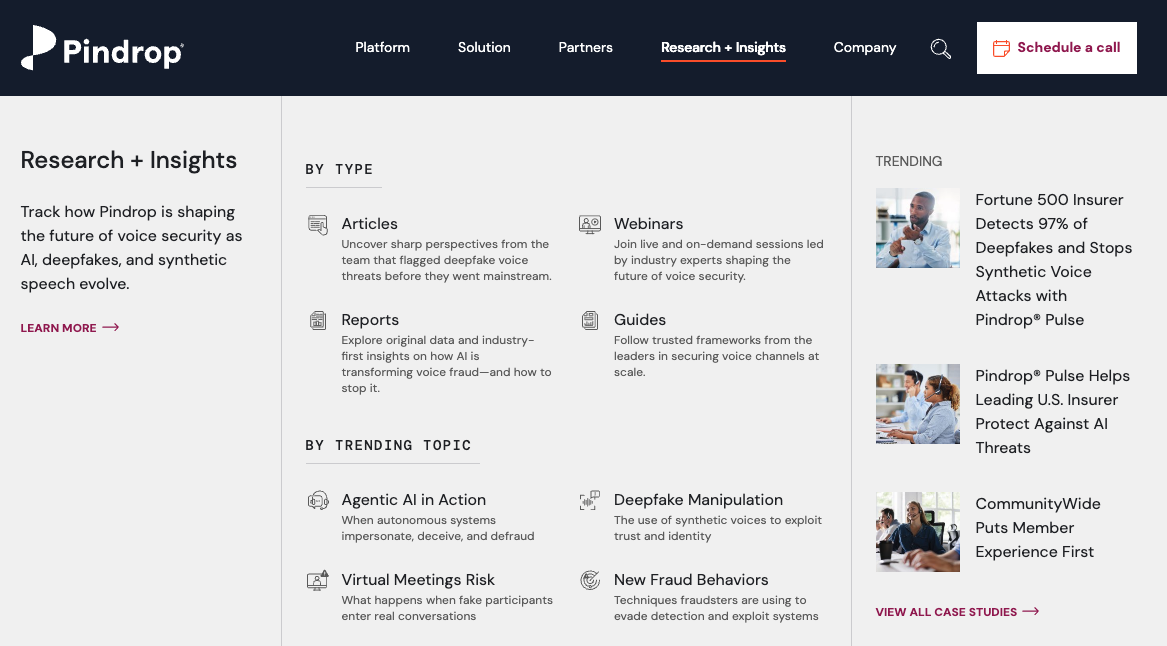
We redesigned the site architecture around real buying journeys—security, fraud, and contact center leaders—rather than internal org charts. That meant new navigation, cleaner URL patterns, and metadata tuned to how people actually search for deepfake detection and authentication. The result: clearer paths for humans, and a stronger foundation for organic, paid, and GEO search.
Sections reimagined
around business goals
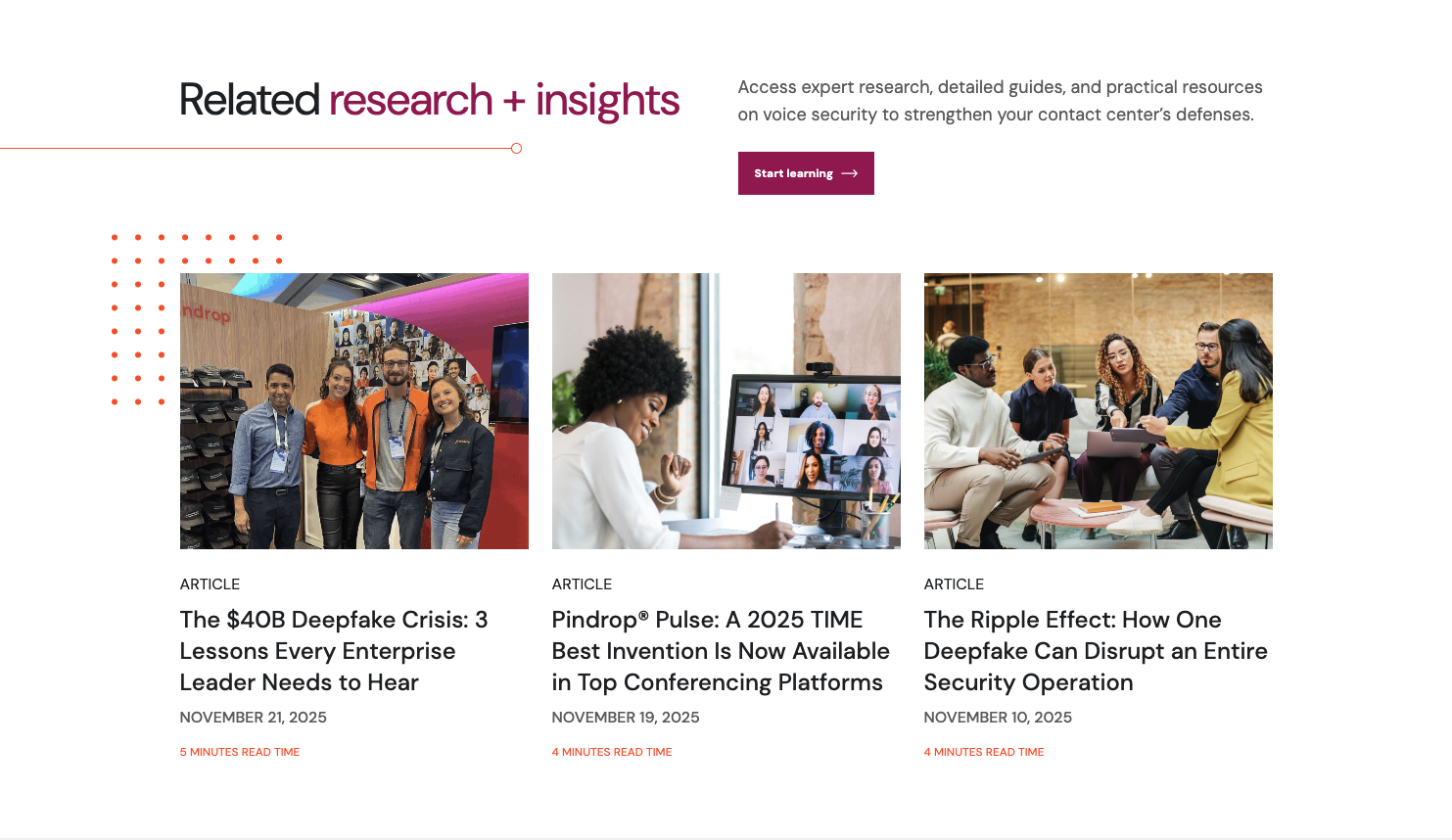
We rethought each major section—Product & Solutions, Research & Insights, and the Newsroom—around specific outcomes. Product and solution pages were rebuilt to answer “how will this work here?”; Research & Insights became a bingeable hub with author pages and topic clusters; and the Newsroom was wired to connect media moments straight into evaluation and demo paths.
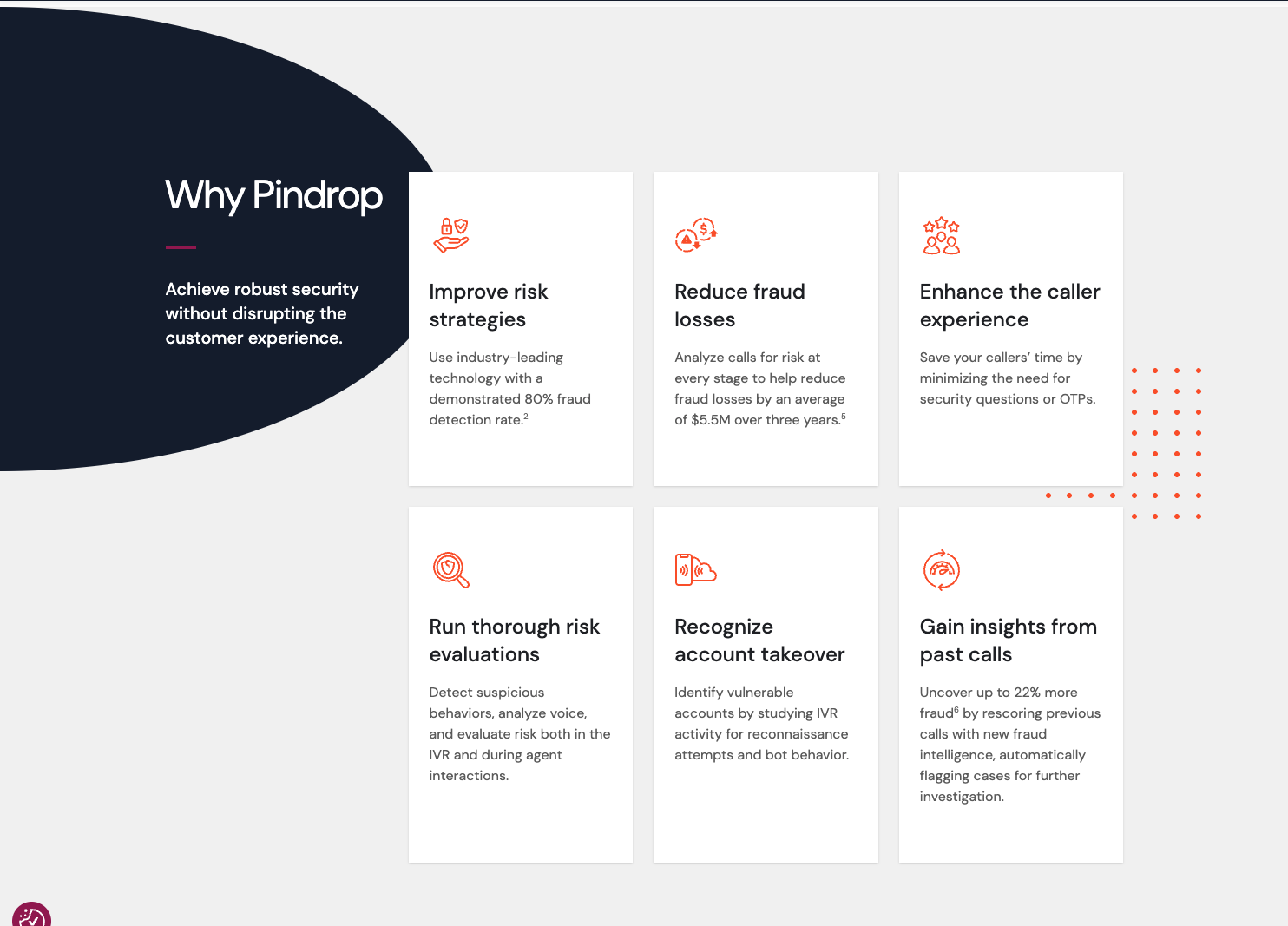
To keep up with launches and narrative shifts, we built AI guardrails so the team could safely use GPT to draft and iterate on web copy. That included tone and structure guidelines, approved prompts, examples of “good” vs. “off-brand” language, and patterns for product pages, solution pages, and research summaries—turning AI into a force multiplier instead of a risk.